Site Search
Problem Solving


Technical Resources


Info Center
Res-Kem Corp
P.O. Box 1059
Media, PA 19063
(P) 610-358-0717
1-800-323-1983
(F) 610-358-4642
 
Contact Us
Brochures
Res-Kem Blog
Certifications
News
General Water


Frequently Asked Questions about Water Treatment >>

For Residential Use For Industrial Use Contact Res-Kem Corp.
  1. Should the vessel for my condensate polisher in our boiler plant be constructed of carbon steel or stainless steel?
  2. Why should I treat my boiler condensate?
  3. Where can I get replacement parts for Solo and Solomatic Valves manufactured by Aquamatic?
  4. How to order GE Aquamatic valves and/or Aquamatic Repair Kits??
  5. What are the special requirements for Pharmaceutical Water Applications??
  6. How do you calculate the size of a Condensate Polisher?
  7. How Does a Softener Valve Nest Work?
  8. How do you dispose of used activated carbon?
  9. Do you have an ion exchange resin equivalency chart?

Should the vessel for my condensate polisher in our boiler plant be constructed of carbon steel or stainless steel?

Over 75% of the condensate polishers that Res-Kem builds utilize stainless steel pressure vessels. If you use a carbon steel vessel it will have to be provided with a high temperature liner for corrosion resistance. For a condensate polisher with a diameter of 30" or less, the liner can not be installed working from inside the tank and the quality of the lining is unpredictable. In fact most liner companies will not warrant their linings if the vessel diameter is less than 36". Stainless steel vessels cost a little more however the entire lining issue goes away as one is not required. For condensate polishers 30" or less in diameter it does not make sense to even consider a carbon steel vessel with a liner. Res-Kem builds a very economical line of standard stainless steel condensate polishers from 20 inch to 66 inch diameter vessels . Our standard designs employ stainless steel vessels, flanged and welded stainless steel face piping. Depending upon the size of the valves we use stainless steel Aquamatic diaphragm and/or butterfly valves. To save a little money, we have an option for smaller size systems using stainless steel vessels, threaded steel face piping, and cast iron Aquamatic diaphragm valves.Condensate Polisher Bulletin

Why should I treat my boiler condensate?

When a condensate system is not properly controlled or simply ignored, corrosion takes place. Iron, copper, and other harmful contaminants are washed back into the boiler systems. This wastes energy because these contaminants reduce heat transfer. From this chart, depending upon the type of contaminant, a layer of 1/32" can waste between 2% and 7% of the fuel used in the boiler. A simple solution is to blow down the boiler to improve water quality, but this wastes heat, requires more makeup water, and increases boiler water chemical usage. The cost effective solution is to "polish" your contaminated condensate for reuse. As more condensate is reused, less make up water is required, reducing both chemical consumption and energy requirements. Condensate Polisher Bulletin

Where can I get replacement parts for Solo and Solomatic Valves manufactured by Aquamatic?

Solo and Solomatic valves, once a staple in the water treatment industry, are now long gone, having been discontinued. Solo and Solomatic valves are no longer manufactured and parts are no longer available to rebuild or repair. So, what can be done should you have a system with good tanks and broken or non-working Solo or Solomatic valve or valves? Any of these systems can be retrofitted using a nest of GE Aquamatic Diaphragm Valves. For automatic Solomatic systems, the controls can be upgraded to the current state-of-art electronic, programmable controls utilizing flow sensors, differential pressure switches, etc. For manual Solo systems, the multiport valve can be replaced with gate or ball valves for strictly manual operation or with Diaphragm Valves for manual, semi or auto initiation via a time clock or differential pressure initiation.

How to order GE Aquamatic valves and/or Aquamatic Repair Kits?

Res-Kem receives many requests for replacement of GE(R) Aquamatic (R) valves and Aquamatic valve repair kits. The easiest way is to contact us. We have many people that can help you through the selection of the correct Aquamatic valve or Aquamatic valve repair kit. If you can have available the following information when you contact us, this would help you quickly get the correct Aquamatic valve. If not, do not worry. We can walk you through the selection.
  • What is the size of the valve?
  • What is the valve made of? Depending upon the valve size it can be cast iron, bronze, stainless steel, or PVC.
  • What are the end connections? Depending upon the valve size and material it can be threaded, flanged, or union fittings.
  • What type of actuator does the valve have? The options are normally open (Standard), normally closed, spring assist closed, spring assist open, limit stop, and position indicator.
  • What is the diaphragm made of? Choices are BUNA (Standard), EPDM, and FKM.
  • What process is the valve used in?

    To help you, on the Res-Kem website we have product information for liquid and air diaphragm valves:
  • Aquamatic 420 Series (421, 424, 425, 426, 427, 428 and 429) metal diaphragm valves
  • Aquamatic 531 Series (531, 534, 535, 537) corrosion reisitant diaphragm valves
  • Aquamatic VAV Series (VAV1, VAV4, VAV5, VAV6, VAV7 and VAV8) air diaphragm valves

    What are the special requirements for Pharmaceutical Water Applications?

    Although we have seen it happen in the past, a water treatment equipment supplier should not simply assume that standard industrial, or commercial water treatment equipment can be installed in a pharmaceutical plant. Please do not be told otherwise, there are substantial differences in design, documentation, materials of construction, fabrication, construction, startup, standard operating procedures (SOP), and maintenance.

    In particular, a water system in a pharmaceutical plant will generally need to be "validated" to comply with the United States Pharmacopeia (USP). There are standards for Purified Water and Water For Injection (WFI) that must be adhered to. Depending upon the water quality, the concerns are for, but not limited to, pyrogens and bacteria. To give you a brief idea of the nature of the complexity, please review the FDA Guide To Inspections Of High Purity Water Systems

    How do you calculate the size of a Condensate Polisher?

    The first thing we need to do is estimate the amount of water that will be used. This chart relates boiler horse power to the flow rate in gallons per minute and pounds per hour. For example, dual 194 HP boliers requires a demineralizer or softener rated for a maximum flow rate of 28 gpm. It will be less depending upon how much condensate is returned.

    The next part of this question is what water quality is needed for the application. The steam pressure and steam boiler manufacturer will help determine what the water quality needs to be. Condensate Polisher Bulletin

    How Does a Softener Valve Nest Work?

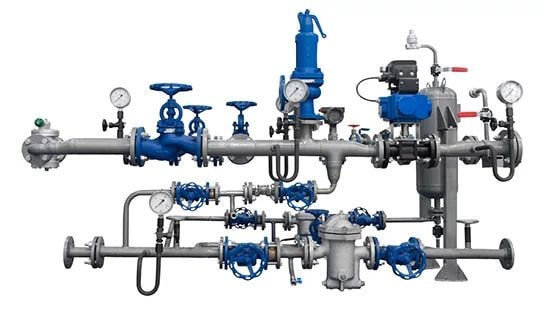
    The "valvenest" for a water softener is made of a minimum of six valves. Res-Kem's standard design uses Aquamatic valves. The easiest way to understand how the water and brine flows through the valvenest is to see this picture.

    The top flange attaches to the upper side port of the softener tank. This in turn connects to the top distributor. The bottom flange of the valvenest attaches to the lower side port of the tank. This is connected internally to the hub and lateral bottom distributor. The regeneration cycle is as follows:
  • Isolation from Service
  • Backwash
  • Brine Draw and Slow Rinse
  • Fast Rinse
  • Return to Service

    How do you dispose of used activated carbon?

    Companies who regularly deal with waste know that getting rid of spent ion exchange resin or activated carbon can be a fairly complicated process. Almost since our founding in 1983, Res-Kem's Technical Services Group has removed (rebedded) spent media, ion exchange resin and activated carbon, from industrial water treatment systems. Part of the rebed service usually includes removal of the spent media from the customer's site. Res-Kem and Calgon Carbon have teamed up to help our customers with spent activated carbon return. As a service to our customers,

    Res-Kem will accept spent carbon at the Aston, PA facility provided the carbon meets the criteria on this form and after receiving an RMA from Res-Kem.

    Do you have an ion exchange resin equivalency chart?

    There are many different ion exchange resin manufacturers including Purolite, Dow, Sybron/Bayer, Thermax, Rohm and Haas and ResinTech. We are often asked to provide a resin that is the closest equivalent to the ion exchange resin they have or need to purchase. This is a list we use internally of the most common ion exchange resins and not an exhaustive of all ion exchange resin equivalencies. Res-Kem does not guarantee the accuracy of this listing. It is, to the best of our knowledge, correct. Please call Res-Kem to confirm a selection.

    Downloads and Technical Information on Res-Kem Equipment, Supplies, and Services

    Click Here for detailed information and downloadable PDF files regarding Res-Kem products and services.

    Contact Res-Kem Corp. - Your Water Treatment Specialist

    Click Here to Contact Res-Kem for further assistance with all your industrial / commercial water treatment needs.


  •