Friday, August 29, 2008

Parts for Solo, Solomatic, Bruner, Brunermatic, Permutit, Aquamatic, Culligan HiFlow Multiport Valves & Others

Routinely, Res-Kem receives requests for quotes for water treatment systems and their replacement parts. One area that frequently needs explanation is replacement parts for multi-port valves including Solo®, Solomatic®, Bruner®, Brunermatic®, Permutit®, and Aquamatic®.

We get questions like:

Please quote the following.:

AQUAMATIC valves with 6 ports total. 5 ports are 3". One in the rear and 4 in cross form. The 6th port is 2", which is the regenerant inlet port.

The fluid flowing through the valves is composed as follows:

1) Hydrochloric acid (HCL) 32% at ambient temp.
2) Sodium Hydroxide NaOH (caustic soda) 50% at ambient temp.
3) Water at ambient temp.

4) Picture of valve attached.

Aquamatic Multi-port Valve

Another Question:

I have a Kisco water softener system with Aquamatic Solomatic Valves. The model number of the system is TWSKOM-300. I need replacement valves. What can I do?


Res-Kem Solution:
As a service company, Res-Kem frequently comes across many different water treatment systems, which have Solo, Solomatic, Bruner, Brunermatic, Permutit and Aquamatic Multiport Valves as well as other manufacturers. Unfortunately, many of these valves and controls for the valves have been discontinued or parts are extremely difficult to find, (which may be due to industry consolidation), and those parts which are available are very expensive. The Res-Kem solution is to replace the multi-port valves with a "valve nest" and an appropriate control system.

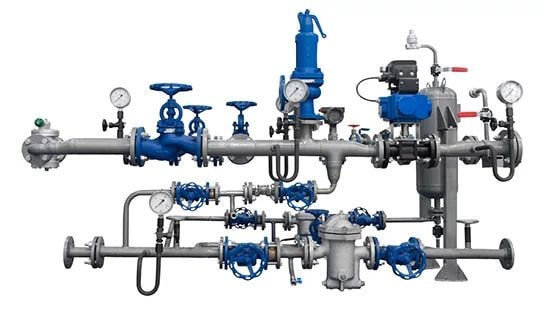
A valve nest performs all the functions of a multiport valve using Aquamatic diaphragm, Keystone butterfly, or other valves as specified by the customer. Using a standard layout with flexibility to account for various tank sizes, a valve nest is a very cost-effective alternative to a multi-port valve.

Res-Kem Corp. Valvenest Replacement for Multi-port Valve

Valve nests can be supplied in a wide variety of materials: Cast iron valves with steel piping, Bronze valves with copper piping, plastic valves with PVC piping, stainless steel valves with stainless steel piping. They can be adapted to filters, softeners, dealkalizers, demineralizers and deionizers.

Labels:

Thursday, August 07, 2008

Type II Anion vs Type I Anion: Ion Exchange Resin Analysis Yields Regeneration Savings

Res-Kem is a supplier of ion exchange resins from several vendors including Purolite. Res-Kem is often asked to diagnose a potential ion exchange resin problem. Depending upon the resin type, cation, anion, or mixed bed, cost and length in service, it may make sense to sample the resin and test for parameters that can identify what has caused the resin not to perform and a potential remedy.

Problem
:
One recent example of the value of an ion exchange resin analysis are the results of two anion samples sent to Res-Kem. The customer was noticing:


  • More frequent regenerations
  • Increased chemical usage
  • Longer rinse times This resulted in a much higher cost to produce water for use.

    They needed a solution.

    Ion Exchange Resin Analysis Reports:

  • Ion Exchange Resin Analysis Report for Train A
    Ion Exchange Resin Analysis Report for Train B

    Discussion of Resin Analysis (Written by Ted Begg of Purolite):

    Train A & B strong base anion resin analysis concluded the samples are Type II Strong Base Anions, equivalent to Purolite A300. Both samples exhibited dramatic loss in strong base capacity and severe organic fouling. Typical Type II anions will have 90% strong base capacity when new, however, it is not uncommon to see severe reduction to the levels observed, ~ 60%, when the resin is continually subjected to temperatures well in excess of 95 degrees F. Strong base capacity is responsible for silica removal. As this capacity is lost, throughput to silica break gets lower and lower with cost of caustic for regeneration steadily increasing. Given caustic is approaching $1000/ dry ton, lost throughput due to resin degradation comes at a very high cost.

    The organic fouling noted is severe and is likely contributing to lost throughput and increased rinse volume (fast rinse). The organics on the resin pick up sodium during caustic regeneration, which slowly elutes off during the fast rinse. Therefore the increased rinse volume.

    The Demineralization System:

    This plant was designed to mix returned hot condensate to the finished water make up storage tank. This water is used for boiler feedwater and as well as for regeneration. While the heated water is beneficial for boiler feedwater, it is not good for regeneration of the anion resins. This water can approach and possibly exceed 130 degrees F. The Type II strong base anion resin temperature limit is stated by manufacturers at 105 degrees F, however, it is more prudent to maintain the limit to a maximum of 95 degrees F. Given the plant operating conditions and the condition of the anion resin, we recommended that the anion be replaced with a more temperature stable product. A Type I porous anion resin with uniform particle size distribution is recommended as a replacement. The product, PFA400, is stable up to 140 degrees F and is more resistant to organic fouling than the incumbent resin. In this case longevity of the resin will improve. The throughput capacity of PFA400 will approach the incumbent resin as well. Thanks Ted for the detailed discussion above of the analyses.

    Our Conclusions and Observations:

    The conclusion is using a Type II anion in place of a Type I, where low silica water is required and the system can run above 95 degrees F, is a misapplication for the reasons stated above which are:


  • Less stable at higher temperatures
  • Strong base sites break down more easily breakdown to weak base sites
  • Lower capacity for silica

    So how does this misapplication happen? The selection of the ion exchange resins for a demineralization system generally occurs many years before a system is started up. Depending upon the perceived complexity of the water treatment system which includes the demineralization system, an engineering company may be specifying the demineralization system components including the resins as well as a whole host of other pieces of equipment. Then these specifications will be bid on by a short or long list of OEM's each of whom wants to get the job. Most will bid to the specs, but others may suggest a cheaper alternative.

    One common area to shave money from the whole job is to skimp on the demineralization system in particlar the anion system. When lowest installed cost is the driver, sometimes Res-Kem sees equipment companies selling deionization systems using a Type II anion resin. The reason they promote the use of a Type II anion is the anion portion of the system is smaller. Because the Type II anion resin has about a 10% higher initial capacity than a Type I, the equipment needs 10% less of the expensive anion resin and the size of the anion tank is smaller. The end result is several months after commissioning and transfer of the equipment from the OEM to the user, the problems begin. By then, the low budget OEM will be on to their next project and will often walk away from your problem.

    Res-Kem believes the moral of the story is work work with a knowledgeable OEM with experienced personnel who will recommend the best equipment for your application and will stand behind their equipment when installed.
  • Labels:

    Thursday, June 26, 2008

    Water Neutralization Saves $23,000 Annually

    Res-Kem has published another white paper on water treatment. This next one is entitled "Bucking the Industry Trend… Simple Change to Water System Saves New Jersey Manufacturer $23,000 Annually"by Kevin Preising.

    This paper details how the addition of an acid water neutralizer (5.5-6 pH) as a pre-treatment step to the Reverse Osmosis system saved over $23,000/year in downstream operation expenses at a New Jersey manufacturing plant. The acid water neutralizer, with an investment of less than $7,000 and operational and labor costs of only $700/year, has a Return on Investment of less than three months. While not a solution for all systems with reverse osmosis and high acidity, discussing neutralization with a qualified vendor can save Electrodeionization and/or Service DI operational expenses.

    What is really interesting about this paper is it shows how a simple acid water neutralizer, properly applied, can save a considerable amount of money on operating expenses.

    Having been in the water treatment industry for two decades, I have seen the trend in the water treatment industry towards more and more complex water treatment technologies and discounting past knowledge as old-fashioned. Often lost is a true understanding of water chemistry by some current "industry experts" and the simple, economic solutions to water treatment problems.

    Please take a look and tell us what you think!

    Labels:

    Tuesday, June 03, 2008

    Activated Carbon: Mesh Size

    We are often questioned about the differences between 1240 (12 by 40) mesh activated carbon and 830 (8 by 30) mesh activated carbon. The 1240 mesh activated carbon is smaller than the 830 activated carbon.

    The screens or the mesh sizes are different. The 12 mesh screen has 12 openings per square inch 12 across and 12 down. The 40 mesh screen has 40 openings per square inch, 40 across and 40 down. Obviously the "holes" of the 12 mesh screen are larger than the "holes" of the 40 mesh screen. It follows that the holes on an 8 mesh screen are larger than 12 and 30 mesh holes are larger than 40 mesh holes.


    Activated Carbon Particle Size Table Courtesy of Calgon Carbon Corporation

    If you would like a laminated card with this guide, contact Res-Kem.

    As part of the manufacturing process the activated carbon companies pass the carbon through various screens to meet the specification.
    Particle Screening System Courtesy of Calgon Carbon Corporation

    So if you look at 1240 mesh activated carbon, it shouldn't have particles larger than 12 mesh or smaller than 40 mesh. The 830 mesh activated carbon shouldn't have particles larger than 8 mesh or smaller than 30 mesh.

    What difference does this make to the user of the activated carbon? The most commonly used activated carbons for residential POE (point of entry) systems, commercial and industrial systems are 830 and 1240 mesh. We use 1240 mesh activated carbon because it has greater surface area and provides excellent chlorine and organics removal. Because the activated carbon filter acts as a mechanical filter in addition to removing chlorine and adsorbing organics, it will accumulate particles of dirt or crud at the top of the bed. An activated carbon filter is backwashed on a regular basis to remove this and prevent pressure loss across the bed.

    In instances where the water contains more turbidity or crud, an 830 mesh activated carbon may be used. Having larger particle size than the 1240 activated carbon, the filter containing 830 mesh activated carbon won't need to be backwashed as often. However, as the particle size increases from a 1240 mesh activated carbon to an 830 mesh carbon, thereby decreasing the backwash flow rate, adsorption capacity will generally decrease.

    When we specify an activated carbon it's important to know the water source. If it's city water or well water from a potable source, we can assume there is little if any turbidity and use of a 1240 mesh activated carbon will work well. If an industrial plant is taking water directly from a river or lake there may be disruptions to the clarification system that may cause excess crud or turbidity. In these cases we see the use of 830 mesh activated carbon.


    Here is a full glossary of activated carbon definitions.

    Labels:

    Wednesday, May 21, 2008

    FILMTECTM BW30LE-440 and BW30LE-4040 RO Elements to be Discontinued

    The Dow Chemical Company recently sent a discontinuation notice for the FILMTEC BW30LE-440 and BW30LE-4040 which have been an industry standard for many years. Dow will not take orders for the current LE elements after May 30, but will honor any orders on the books even if shipment is not until the end of the year.

    The good news is FilmTec Corporation has developed a new Low Energy, LE, membrane. FILMTEC elements rolled from this LE membrane have the highest active membrane areas, and operate at lower pressure reducing operating costs.

    FILMTEC LE-440i:
    This RO membrane element replaces the FILMTEC BW30LE-4040 RO Element. The FILMTEC LE-440i has 440 square feet of RO membrane which is the highest active membrane area in the industry.

    The FILMTEC LE-440i element:
  • Has 10% higher productivity than the FILMTEC BW30LE-4040
  • Operates at lower pressure
  • Maintains High Rejection
  • Minimizes operating expense
  • Reduces total cost to produce industrial, commercial, or municipal water
  • Incorporates iLECTM interlocking endcaps minimizes O-ring leaks which improves permeate quality

    FILMTEC< LE-400 element:
    This RO membrane element replaces the FILMTEC BW30LE-440 RO Element. The FILMTEC LE-400 has 400 square feet of RO membrane.

    The FILMTEC LE-400i element:
  • Has higher salt rejection for better permeate quality
  • Operates at lower pressure
  • Minimizes operating expense
  • Reduces energy cost to produce industrial, commercial, or municipal water

    Labels:


  •